
 Poradmin
By being proactive with your bookkeeping, you’ll save your small business time when it comes to taxes. Simply turn your financial statements over to your CPA or other tax filings expert, and let them handle the rest. Using the data you gain from keeping a ledger, your next step will be to generate and prepare financial reports for analysis. The major reports to include are the profit and loss, the balance sheet, and a cash flow analysis. Additionally, the aged accounts receivables and aged accounts payables reports are helpful in knowing which customers have not paid and which vendors are yet to be paid. These reports will help you gain greater insights into the financial health of your small business.
Remember, VC-backed companies have different needs than traditional small businesses or solo entrepreneurs. We recommend QuickBooks Online (“QBO”) as the right bookkeeping software for startups and high-growth small businesses. startup bookkeeping It’s the leading small business accounting software in the US for small businesses, and interfaces nicely with other automated systems like payroll. Deferred Revenue is when a client pays you ahead of you delivering a service.
Most of the best accounting software programs will help you track your business income and business expenses automatically without you having to create spreadsheets and do manual data entry. Small business accounting software can generate them, but you may need an accounting professional to analyze them and tell you in concrete terms what they mean for your company. Most are the type that any small business owner could customize, generate, and understand. You can also match related transactions, such as an invoice entered into the system and a corresponding payment that has come through.
As its name implies, Northwest Registered Agent is a platform that primarily offers registered agent services to customers. The company also offers additional services for forming LLCs, corporations and a wide range of other business formation tasks. ZenBusiness has LLC formation packages starting at $0 plus state filing fees. During my sign-up process, various add-ons were suggested to me that were free for the first month or year.

5 Tips for Effective Small-Business Bookkeeping.
Posted: Fri, 16 Jul 2021 07:00:00 GMT [source]
In the last 10 years, Organization Ink has worked with over 70 businesses, many of which receive regular, ongoing support until they are ready to hire someone in a full-time position. Costs will vary widely https://www.bookstime.com/ depending on where you are located, what states you do business in and whether you choose an accountant or an accounting firm. As a general rule, you will either pay a fee per service, or an hourly rate.


Poradmin
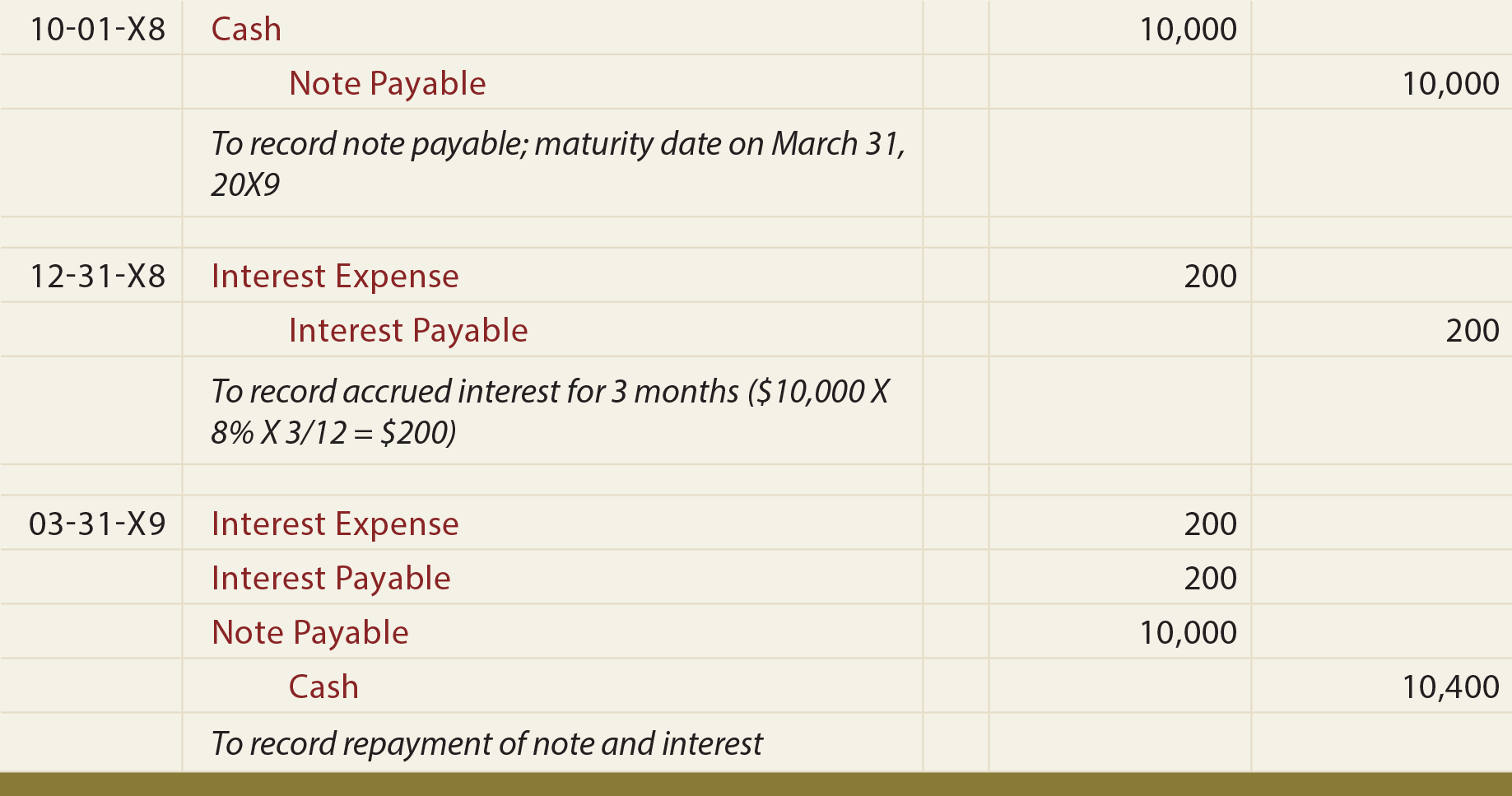
If it is a compound interest, the accrued interest that remains unpaid is added to the principal of note receivable and carried over to the next accounting period. For non-current asset classification, the company must reevaluate the note receivable at the end of each accounting period to identify if its classification has changed. Notes receivable come in the form of a written document that borrowers pay to their lenders. Unlike usual trading balances and credits, notes receivable balances come with additional terms. The journal entry for interest on a note receivable is to debit the interest income account and credit the cash account. For example, the non-interest-bearing note that the company XYZ receives is a $1,000 promissory note with a 2-year maturity and an appropriate discount rate is 8% per annum.
Sometimes accounts receivables are converted into notes receivables to allow the debtors to pay the balance. Notes receivable can arise due to loans, advances to employees, or from higher-risk customers who need to extend the payment period of an outstanding account receivable. Notes can also be used for sales of property, plant, and equipment or for exchanges of long-term assets. Notes arising from loans usually identify collateral security in the form of assets of the borrower that the lender can seize if the note is not paid at the maturity date. As you’ve learned, accounts receivable is typically a more informal arrangement between a company and customer that is resolved within a year and does not include interest payments.
Before realization of the maturity date, the note is accumulating interest revenue for the lender. Interest is a monetary incentive to the lender that justifies loan risk. The interest rate is the part of a loan charged to the borrower, expressed as an annual percentage of the outstanding loan amount. Interest is accrued daily, and this accumulation must be recorded periodically (each month for example). The Revenue Recognition Principle requires that the interest revenue accrued is recorded in the period when earned.
The amount debited to interest receivable represent simple interest earned on note receivable from ABC. Are known, the fifth “unknown” variable amount can be determined using a business calculator or an Excel net present value function. For example, if the interest rate (I/Y) is not known, it can be derived if all the other variables in the equation are known.
In contrast, notes receivable (an asset) is a more formal legal contract between the buyer and the company, which requires a specific payment amount at a predetermined future date. The length of contract is typically over a year, or beyond one operating cycle. There is also generally an interest requirement because the financial loan amount may be larger than accounts receivable, and the length of contract is possibly longer.
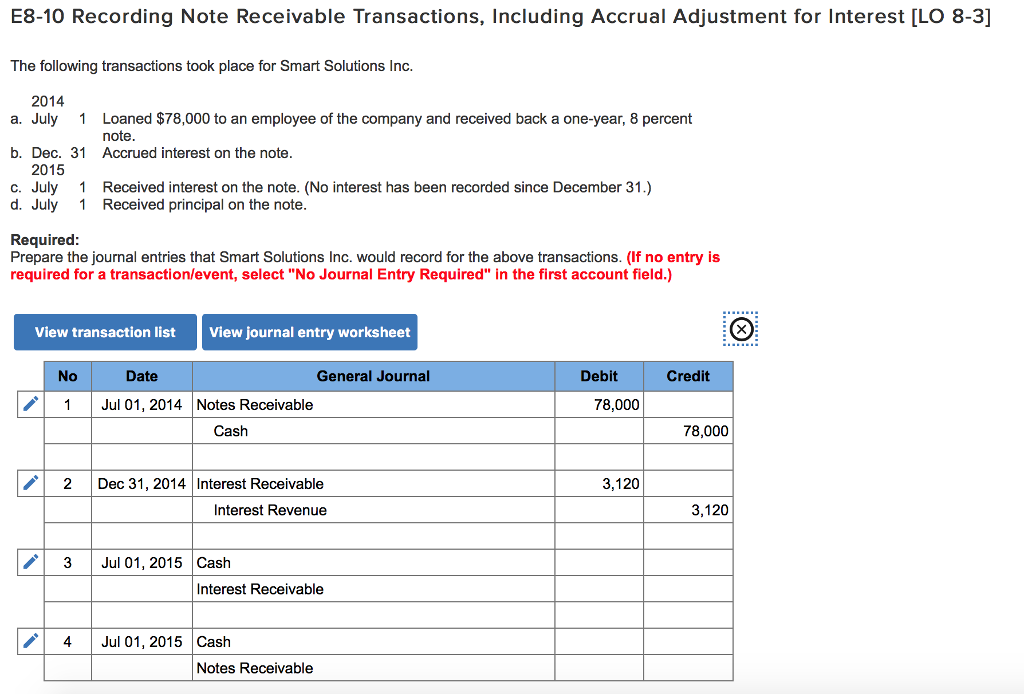
For this reason, notes are negotiable instruments the same as cheques and bank drafts. The journal entry will follow if a company pays another party directly in exchange for a note receivable. In this journal entry, the balance of note receivable will increase by the amount of interest income of the month.
For the purposes of accounting class, we will focus on Accounts Receivable transactions where an Accounts Receivable is turned into a Note Receivable. It has a stronger legal claim than Accounts Receivable, meaning it is more likely to get paid than Accounts Receivable if the maker enters bankruptcy. For how to find the best tax preparer for you Notes due in less than one year, Notes Receivable accounts are listed in the Current Asset section of the Balance Sheet. Notes Receivable due in more than one year are listed in the Long-term Asset section of the Balance Sheet. Where I/Y is interest of .75% each month (9%/12 months) for six months.
In any event, the Notes Receivable account is at the face, or principal, of the note. No interest income is recorded at the date of the issue because no interest has yet been earned. Also, if customers are known to default on paying their accounts, the seller may insist that they sign a note for the balance. The first journal is to record the principal amount of the note receivable.
Square, the mobile payments company, allows small businesses to take credit cards by swiping customer credit cards using a small square device attached to the audio jack found on mobile devices. Since its founding in 2009 and the launch of its first app in 2010, Square has found its way into many small businesses – and large businesses. Starbucks uses Square to process transactions with credit or debit card customers. In November 2014, Square announced that it would be accepting Apple Pay. After 60 days of non-payment, notes payable are issued to MPC by RSP Co. for USD60,000 at an interest rate of 10% per annum and with a payment of USD20,000 due at the end of each of the next 90 days.
We are transitioning the debt from Accounts Receivable to Notes Receivable. Note that some textbooks use 360 days in a year, and some textbooks use 365 days in a year. Using 360 days is a throwback to the very olden days when “calculators” were people who calculated. Square determines the amount to be charged for the loan and the percentage to be charged each day using data analytics.
Poradmin
Rather than just a few chosen tasks, outsourcing accounting enables you to offer bundled service offerings. In addition to tax preparation, they perform other duties like month-end financial reporting, tax advisory, and monthly bookkeeping services. They can either work directly for your clients on a referral basis or through a white-label accounting solution on the back end while you remain on the customer-facing side. Since 2005, Maxim Liberty has offered flexible and affordable outsourced bookkeeping services for CPA firms in Canada and the United States. With plans starting at just $50 a month and the ability to cancel anytime, Maxim Liberty ranks highly in the industry for its high-value bookkeeping services. At QXAS outsourcing, we excel in delivering streamlined auditing solutions.
Prioritize critical tasks essential to your firm’s long-term success while your outsourced accounting team manages routine tasks. Permanently increase your firm’s capacity with a dedicated outsourced accounting team in weeks, not months. Virtual, online, and outsourced accounting can appear the same at first glance, but these terms should not https://quickbooks-payroll.org/ be used interchangeably. However, the difference is simple – ‘All offshore/onshore accounting outsourcing is online or virtual accounting, but all online or virtual accounting is not outsourced accounting. Unlike most other outsourced bookkeepers on our list, Merritt Bookkeeping doesn’t offer any in-house add-ons for payroll and tax services.
So, it is advisable to ask this question to know whether the outsourcing firm can scale up the association with your firm when needed. You must understand the levels of expertise and skillsets of the outsourced accountants working on your project. Also, make sure they have the requisite experience in the kind of work you send their way. Christopher Rivera, Chris serves contribution margin as a Director of Client Relations and Business Development at Entigrity. His expertise in sales, training, coaching, mentoring and influencing combined with his competitive nature makes him a strong leader. Chris has traveled through the length and width of the country and has spoken with more than five thousand CPAs, understanding their challenges and limitations.
For most firms, the journey to accounting outsourcing starts with the need to cut costs and improve scalability during the busy season. While security is an overriding concern with outsourcing, virtual solutions offer expert data protection regardless of the areas outsourced. International services are a thriving area of growth for accounting practices of all sizes.
There are several actions that could trigger this block including submitting a certain word or phrase, a SQL command or malformed data. You can choose Bench if your business has not entered the growth stage yet and it will take some time for your financials to change. So you do not spend on the expensive software but get to reap all the benefits that it has to offer just by paying a monthly fee. As a small business, you might not have sufficient budget to invest in expensive up-to-date software for financial reporting for your business. Businesses often work for years on the same outdated software and miss out on the latest technologies.
Witness Diana’s journey from establishing her CPA firm in the 2020 to harnessing the power of outsourcing, resulting in remarkable client expansion and increased profitability. This is one of the reasons why I like being on the Tax Council because small firms like ours can get the word out there that there is another way. So first you need to identify the kind of solution that your business needs and then pick a solution that best fits it. Before getting started, you will need to have all your bank accounts and records of transactions in place. If you are a small business with under a hundred transactions, the Basic plan might be ideal. If you are currently going through funding rounds, inDinero also has resources to guide businesses through these funding stages.
Give your team the freedom to focus on delivering strategic growth for your firm rather than drowning in non-essential busy work. Outsmart your competitors by adding highly skilled accounting professionals to your firm faster. Check whether the provider has implemented the necessary security controls and is compliant with the required compliance frameworks such as SOC 2, GDPR, ISO 27701, and others. Effective communication with an outsourced team can sometimes be challenging due to differences in time zones and potential language barriers.
Non-profit organizations and charities can also benefit from their expertise. But, payroll, taxes, and invoices are not inclusive of this low-cost service. Instead choose one that integrates with QuickBooks, NetSuite, Xero, and other best accounting software. Also, look for integration for tax and payroll services and other backend processes. QX Accountng Services is a pioneer in bringing a selection of accounting outsourcing services for your accounting firm’s laborious accounting functions.
SmartBooks not only takes care of the bookkeeping for small businesses but provides many other valuable financial services to help small businesses manage their accounts and financial health with ease. ROSE® is a leading Finance as a Service (FaaS) provider, simplifying back-office operations by aligning People, Process, Technology, Organization, and Data. Our cutting-edge system, Easby®, is an enterprise-grade, ai-enabled, hyper-automation system of engagement that transforms data into actionable insights to enhance financial performance.
These savings mean the downward price pressure will not affect your profitability. Outsourcing financial activities are the key to productivity and accuracy. Ignite Spot Accounting delivers heftier reports than many other cloud accounting providers we checked out for this piece. Along with typical financial reporting (like profit and loss reports and balance sheets), you’ll get a KPI (key performance indicator) report and profitability analysis, among others. You have to enter more information about your needs to get a quote—which is useful if you want truly customized services but unhelpful if you’d rather choose a basic plan out of a lineup. With outsourced accounting services, you are taking actionable steps to scale your firm and increase the scope of services.
The Premium plan ($399 a month if billed annually or $499 billed monthly) adds tax advising services, end-of-year tax filing, and financial strategy planning. The team at QX Accounting Services then takes over various accounting tasks, ranging from routine bookkeeping to complex tax preparation and financial analysis. They utilize advanced accounting software and maintain consistent communication with the client to ensure accuracy and transparency. Regular reports and insights are provided, enabling firms to make informed decisions. Full-service outsourcing partners are also available that can offer more substantial accounting services.
Also, check whether the migration of data between the two services is not complex. The business will also follow statutory laws by maintaining financial records. You will also be able to provide quantitative information to investors, managers, and government.
Ultimately, whether to outsource accounting depends on the firm’s specific needs, but the potential benefits make it a strategy worth considering for efficiency, growth, and competitive advantage. Paro only accepts the top 2% of applicants with 15 years of experience on average to their platform. These individuals can be hired on demand to fill temporary vacancies or partner with you long-term. However, while your outsourcing partner can prepare these statements to save you time and resources, you will likely review them for accuracy before passing them on to your clients. The integration of AI in accounting has been a measured journey marked by careful acceptance and steady adoption. Today, AI is not merely a trendy term in the accounting industry; it’s a transformative tool reshaping the execution of accounting tasks.
Poradmin
Assets are typically listed as individual line items and then as total assets in a balance sheet. You will need to tally up all your assets of the company on the balance sheet as of that date. Noncurrent or long-term liabilities are debts and other non-debt financial obligations that a company does https://www.wave-accounting.net/ not expect to repay within one year from the date of the balance sheet. For instance, if a company takes out a ten-year, $8,000 loan from a bank, the assets of the company will increase by $8,000. Its liabilities will also increase by $8,000, balancing the two sides of the accounting equation.
These revenues will be balanced on the asset side of the equation, appearing as inventory, cash, investments, or other assets. If the company takes $10,000 from its investors, its assets and stockholders’ equity will also increase by that amount. Horizontal balance sheets show Assets on the left side and Liabilities and Shareholders’ Equity on the right side of the balance sheet.
If a balance sheet doesn’t balance, it’s likely the document was prepared incorrectly. External auditors, on the other hand, might use a balance sheet to ensure a company is complying with any reporting laws it’s subject to. Typically, a balance sheet will be prepared and distributed on a quarterly or monthly basis, depending on the frequency of reporting as determined by law or company policy. Here’s everything you need to know about understanding a balance sheet, including what it is, the information it contains, why it’s so important, and the underlying mechanics of how it works. Although balance sheets are important, they do have their limitations, and business owners must be aware of them. It is also helpful to pay attention to the footnotes in the balance sheets to check what accounting systems are being used and to look out for red flags.
Businesses compute Days Receivable Outstanding (DRO) and Days Payable Outstanding (DPO), which relate to accounts receivable and accounts payable turnover. Liabilities are presented as line items, subtotaled, and totaled on the balance sheet. Now that we have seen some sample balance sheets, we will describe each section of the balance sheet in detail. We also allow you to split your payment across 2 separate credit card transactions or send a payment link email to another person on your behalf. If splitting your payment into 2 transactions, a minimum payment of $350 is required for the first transaction.
On the other hand, balance sheets for mid-size private firms might be prepared internally and then reviewed over by an external accountant. The data and information included in a balance sheet can sometimes be manipulated by management in order to present a more favorable financial position for the company. Business owners use these financial ratios to assess the profitability, solvency, liquidity, and turnover of a company and establish ways to improve the financial health of the company. Using financial ratios in analyzing a balance sheet, like the debt-to-equity ratio, can produce a good sense of the financial condition of the company and its operational efficiency.
Note that in our model, the “Total Assets” and “Total Liabilities” line items include the values of the “Total Current Assets” and “Total Current Liabilities”, respectively. In other instances, it is common to see the two separated into bookkeeping for auto repair shops “Current” and “Non-Current”. But rather than copying every single data point in the same format as reported by Apple in their public filings, discretionary adjustments that we deem appropriate must be made for modeling purposes.
Long-term liabilities, on the other hand, are due at any point after one year. This is the value of funds that shareholders have invested in the company. When a company is first formed, shareholders will typically put in cash. Cash (an asset) rises by $10M, and Share Capital (an equity account) rises by $10M, balancing out the balance sheet.
It might seem overwhelming at first, but getting a handle on everything early will set you up for success in the future. Today, we’ll go over what a balance sheet is and how to master it to keep accurate financial records. Depending on the company, different parties may be responsible for preparing the balance sheet. For small privately-held businesses, the balance sheet might be prepared by the owner or by a company bookkeeper. For mid-size private firms, they might be prepared internally and then looked over by an external accountant.
This is an important document for potential investors and loan providers. When investors ask for a balance sheet, they want to make sure it’s accurate to the current time period. It’s important to keep accurate balance sheets regularly for this reason. Total assets is calculated as the sum of all short-term, long-term, and other assets. Total liabilities is calculated as the sum of all short-term, long-term and other liabilities. Total equity is calculated as the sum of net income, retained earnings, owner contributions, and share of stock issued.
That is, assets are on the left; liabilities and stockholders’ equity are on the right. If you’ve found that your balance sheet doesn’t balance, there’s likely a problem with some of the accounting data you’ve relied on. Double check that all of your entries are, in fact, correct and accurate. You may have omitted or duplicated assets, liabilities, or equity, or miscalculated your totals.
Using the screenshot from earlier, we’ll enter Apple’s historical balance sheet into Excel. The three parts of the balance sheet are described in the following table. Liabilities may also include an obligation to provide goods or services in the future.
It is also known as net assets since it is equivalent to the total assets of a company minus its liabilities or the debt it owes to non-shareholders. Accounts within this segment are listed from top to bottom in order of their liquidity. They are divided into current assets, which can be converted to cash in one year or less; and non-current or long-term assets, which cannot.
Apple’s total liabilities increased, total equity decreased, and the combination of the two reconcile to the company’s total assets. Understanding and analyzing key financial statements like the balance sheet, income statement, and cash flow statement is critical to painting a clear picture of a business’s past, present, and future performance. Knowing what goes into preparing these documents can also be insightful. Balance sheets are one of the core financial statements presented in business plans and financial models for analyzing potential M&A transactions and establishing a valuation. These balance sheets are prepared with assumptions as estimated projections of future assets, liabilities, and shareholders’ equity. Although the balance sheet is an invaluable piece of information for investors and analysts, there are some drawbacks.
The common stock and preferred stock accounts are calculated by multiplying the par value by the number of shares issued. Includes non-AP obligations that are due within one year’s time or within one operating cycle for the company (whichever is longest). Notes payable may also have a long-term version, which includes notes with a maturity of more than one year.
Poradmin
EPS is a financial ratio, which divides net earnings available to common shareholders by the average outstanding shares over a certain period of time. The EPS formula indicates a company’s ability to produce net profits for common shareholders. Another critical limitation of price-to-earnings ratios lies within the formula for calculating P/E. P/E ratios rely on accurately presenting the market value of shares and earnings per share estimates.
The resulting number serves as an indicator of a company’s profitability. It is common for a company to report EPS that is adjusted for extraordinary items and potential share dilution. Another helpful tool is the price-to-book, or P/B ratio, which compares a company’s stock price to the value of its assets on the balance sheet. A lower P/B ratio can sometimes indicate that the stock is at a reasonable valuation. Let’s say that stock A, with its P/E of 10, has forward annual earnings growth estimated at 10% for the next five years.
For example, a low P/E ratio could suggest a stock is undervalued and worth buying. However, including the company’s growth rate to get its PEG ratio might tell a different story. PEG ratios can be termed “trailing” if using historical growth rates or “forward” if using projected growth rates.
The E/P ratio increases with earnings and decreases with increases in the stock price. To calculate a company’s EPS, the balance sheet and income statement are used to find the period-end number of common shares, dividends paid on preferred stock (if any), and the net income or earnings. It is more accurate to use a weighted average number of common shares over the reporting term because the number of shares can change over time. As an example, assume a fictitious Widget Co. is trading at $10 and will earn $1 in EPS over the year ahead. If it pays out the entire amount as dividends, the company would have an indicated dividend yield of 10%.
Since it does account for a company’s debt load, the EV/Sales ratio is said to be superior, although it involves more steps and isn’t always as readily available. It’s calculated by dividing the current stock price by the company’s earnings per share (EPS). EPS is the earnings for the previous 12 months divided by the number of outstanding shares of stock. The price-to-sales ratio (P/S) shows how much the market values every dollar of the company’s sales. To calculate it, take the company’s market capitalization and divide it by the company’s total sales over the past 12 months. A company’s market cap is the number of shares issued multiplied by the share price.
A PEG of more than 1 is typically taken to indicate that the company is overvalued. To get a clearer picture of value, the PEG of the company should also be compared with the PEG of the market and with the industry that the company competes in. The payout ratio could also be calculated by merely dividing the DPS ($2.87) by the EPS ($3.66) for the past year. Like any other fundamental metric, the price-to-earnings ratio comes with a few limitations that are important to understand. Companies that aren’t profitable and have no earnings—or negative earnings per share—pose a challenge for calculating P/E. Some say there is a negative P/E, others assign a P/E of 0, while most just say the P/E doesn’t exist (N/A) until a company becomes profitable.
Earnings per share and the company’s overall P/E ratio may go negative briefly. A negative P/E ratio means a business has negative earnings or is losing money. Even the best companies go through periods when they are unprofitable. While the P/E ratio is frequently used to measure a company’s value, its ability to predict future returns is a matter of debate. The P/E ratio is not a sound indicator of the short-term price movements of a stock or index.
Some investors value a stock by how much cash flow the company generates. They may monitor mergers and acquisitions in the company’s industry to see the type of valuations given to the company’s competitors. If the company pays dividends, investors can check the dividend yield and whether it’s increasing.
Earnings per share (EPS) is an important profitability measure used in relating a stock’s price to a company’s actual earnings. In general, higher EPS is better but one has to consider the number of shares outstanding, the potential for share dilution, and earnings trends over time. If a company misses or beats analysts’ consensus expectations for EPS, their shares can either crash or rally, respectively.
The P/E ratio also helps investors determine a stock’s market value compared with the company’s earnings. That is, the P/E ratio shows what the market is willing to pay today for a stock based on its past or future earnings. A high P/E ratio could signal your digital assets that a stock’s price is high relative to earnings and is overvalued. Conversely, a low P/E could indicate that the stock price is low relative to earnings. Investors often base their purchases on potential earnings, not historical performance.
She recommends price-to-sales (P/S) or price-to-free cash flow (P/FCF). Simply replace the EPS calculation on the bottom of the equation with the company’s sales or free cash flow. If you want to verify the website’s calculations or just prefer to crunch your own numbers, you can usually find EPS on a company’s income statement below net income. Higher P/S ratios may indicate a company is not efficiently using investor funds to drive revenue.
“It’s better to compare the EPS for similar companies as the interpretation can be subjective otherwise.” If Stock B is trading at $20 and its EPS (ttm) was $2, it has a P/E of 10 (i.e., $20/$2) and an earnings yield of 10% ($2/$20). A P/E ratio of N/A means the ratio is unavailable for that company’s stock. A company can have a P/E ratio of N/A if it’s newly listed on the stock exchange and has not yet reported earnings, such as with an initial public offering.
The P/S ratio, also known as a sales multiple or revenue multiple, is a key analysis and valuation tool for investors and analysts. The ratio shows how much investors are willing to pay per dollar of sales. Like all ratios, the P/S ratio is most relevant when used to compare companies in the same sector. A low ratio may indicate the stock is undervalued, while a ratio that is significantly above the average may suggest overvaluation.
Companies may choose to buy back their own shares in the open market to improve EPS. The better EPS results from the net income being divided up by a fewer number of shares. Diluted EPS, which accounts for the impact of convertible preferred shares, options, warrants, and other dilutive securities, was $1.56. To better illustrate the effects of additional securities on per-share https://www.wave-accounting.net/ earnings, companies also report the diluted EPS, which assumes that all shares that could be outstanding have been issued. If you have an interest in stock trading or investing, your next step is to choose a broker that works for your investment style. In other words, most metrics by themselves can’t be used in a vacuum; you have to look at growth rates and risk together.
These different versions of EPS form the basis of trailing and forward P/E, respectively. The P/E ratio is a key tool to help you compare the valuations of individual stocks or entire stock indexes, such as the S&P 500. In this article, we’ll explore the P/E ratio in depth, learn how to calculate a P/E ratio, and understand how it can help you make sound investment decisions. The earnings yield is also related to the return on equity (ROE), which is simply the earnings per book value, and can be found by multiplying the earnings yield (E/P) by the price/book value (P/B). Shareholders might be misled if the windfall is included in the numerator of the EPS equation, so it is excluded.
But what if there is a glut of widgets in the market and Widget Co. begins trading at a big discount to book value? In that case, rather than a 10% return, the investor may incur a loss from the Widget Co. holdings. As such, one should only use P/E as a comparative tool when considering companies in the same sector because this is the only kind that will provide worthwhile results. For example, comparing the P/E ratios of a telecommunications company and the P/E of an oil and gas drilling company could suggest one is the superior investment, but that’s not a cogent conclusion. An individual company’s high P/E ratio, for example, would be less cause for concern when the entire sector has high P/E ratios. In this way, some believe that the PEG Ratio is a more accurate measure of value than the P/E ratio.
Its banking subsidiary, Charles Schwab Bank, SSB (member FDIC and an Equal Housing Lender), provides deposit and lending services and products. Access to Electronic Services may be limited or unavailable during periods of peak demand, market volatility, systems upgrade, maintenance, or for other reasons. For example, if stock A has a P/E of 10 and stock B’s P/E stands at 15, it tells nothing about the growth trajectory of the companies. If stock B is growing at an 18% clip and stock A is pushing along at a 10% rate, many investors might prefer to pay 15 times for 18% growth than 10 times for 10% growth. Companies heavy with corporate debt and on the verge of bankruptcy, however, can emerge with low P/S.
Poradmin
Because debt is inherently risky, lenders and investors tend to favor businesses with lower D/E ratios. For shareholders, it means a decreased probability of bankruptcy in the event of an economic downturn. A company with a higher ratio than its industry average, therefore, may have difficulty securing additional funding from either source. The Debt to Equity Ratio (D/E) measures a company’s financial risk by comparing its total outstanding debt obligations to the value of its shareholders’ equity account. A company’s total debt is the sum of short-term debt, long-term debt, and other fixed payment obligations (such as capital leases) of a business that are incurred while under normal operating cycles. An increase in the D/E ratio can be a sign that a company is taking on too much debt and may not be able to generate enough cash flow to cover its obligations.
This is also true for an individual applying for a small business loan or a line of credit. If the business owner has a good personal D/E ratio, it is more likely that they can continue making loan payments until their debt-financed investment starts paying off. The cash ratio provides an estimate of the ability of a company to pay off its short-term debt. This calculation gives you the proportion of how much debt the company is using to finance its business operations compared to how much equity is being used.
However, in this situation, the company is not putting all that cash to work. Investors may become dissatisfied with the lack of investment or they may demand a share of that cash in the form of dividend tips for submitting your nih grant application payments. They do so because they consider this kind of debt to be riskier than short-term debt, which must be repaid in one year or less and is often less expensive than long-term debt.
The benefit of debt capital is that it allows businesses to leverage a small amount of money into a much larger sum and repay it over time. This allows businesses to fund expansion projects more quickly than might otherwise be possible, theoretically increasing profits at an accelerated rate. Let’s look at a real-life example of one of the leading tech companies by market cap, Apple, to find out its D/E ratio. When you look at the balance sheet for the fiscal year ended 2021, Apple had total liabilities of $287 billion and total shareholders’ equity of $63 billion. From the above, we can calculate our company’s current assets as $195m and total assets as $295m in the first year of the forecast – and on the other side, $120m in total debt in the same period. For example, let’s say a company carries $200 million in total debt and $100 million in shareholders’ equity per its balance sheet.
If the company is aggressively expanding its operations and taking on more debt to finance its growth, the D/E ratio will be high. In contrast, service companies usually have lower D/E ratios because they do not need as much money to finance their operations. Tesla had total liabilities of $30,548,000 and total shareholders’ equity of $30,189,000. The debt capital is given by the lender, who only receives the repayment of capital plus interest.
However, industries may have an increase in the D/E ratio due to the nature of their business. For example, capital-intensive companies such as utilities and manufacturers tend to have higher D/E ratios than other companies. The current ratio measures the capacity of a company to pay its short-term obligations in a year or less.
However, it could also mean the company issued shareholders significant dividends. By contrast, higher D/E ratios imply the company’s operations depend more on debt capital – which means creditors have greater claims on the assets of the company in a liquidation scenario. However, a low D/E ratio is not necessarily a positive sign, as the company could be relying too much on equity financing, which is costlier than debt. If the debt to equity ratio gets too high, the cost of borrowing will skyrocket, as will the cost of equity, and the company’s WACC will get extremely high, driving down its share price. Finally, if we assume that the company will not default over the next year, then debt due sooner shouldn’t be a concern.
The debt-to-equity ratio or D/E ratio is an important metric in finance that measures the financial leverage of a company and evaluates the extent to which it can cover its debt. It is calculated by dividing the total liabilities by the shareholder equity of the company. The debt-to-equity ratio is one https://simple-accounting.org/ of the most commonly used leverage ratios. The debt-to-equity ratio is calculated by dividing total liabilities by shareholders’ equity or capital. If, as per the balance sheet, the total debt of a business is worth $50 million and the total equity is worth $120 million, then debt-to-equity is 0.42.
Conversely, a lower ratio indicates that the company primarily uses equity, which doesn’t require repayment but might dilute ownership. So while the debt-to-equity ratio is not perfect, the others are not perfect either. That is why it is advantageous for businesses and financial institutions to pay attention to the different ratios.
“For example, a transport company has to borrow a lot to buy its fleet of trucks, while a service company will practically only have to buy computers,” explains Lemieux. On the other hand, a business could have $900,000 in debt and $100,000 in equity, so a ratio of 9. “In a case like that, the lenders almost completely financed the business,” says Lemieux. “It’s a very low-debt company that is funded largely by shareholder assets,” says Pierre Lemieux, Director, Major Accounts, BDC. Like the D/E ratio, all other gearing ratios must be examined in the context of the company’s industry and competitors.
Personal D/E ratio is often used when an individual or a small business is applying for a loan. Lenders use the D/E figure to assess a loan applicant’s ability to continue making loan payments in the event of a temporary loss of income. The quick ratio is also a more conservative estimate of how liquid a company is and is considered to be a true indicator of short-term cash capabilities. Quick assets are those most liquid current assets that can quickly be converted into cash.
Likewise, economists and other professionals use it as one of the metrics that show the company’s financial health and its lending risk. If a company takes out a loan for $100,000, then we would expect its D/E ratio to increase. Our company now has $500,000 in liabilities and still has $600,000 in shareholders’ equity. Total assets have increased to $1,100,000 due to the additional cash received from the loan. It is crucial to consider the industry norms and the company’s financial strategy when assessing whether or not a D/E ratio is good.
The equity ratio represents the proportion of a company’s total assets that are financed by its shareholders’ equity. It is calculated by dividing equity by total assets, indicating financial stability. In the case of Company XYZ, the DE ratio of 1.5 suggests that the company is relying heavily on debt to finance its operations, which could increase its risk of default and bankruptcy.
Registration granted by SEBI, membership of BASL (in case of IAs) and certification from NISM in no way guarantee performance of the intermediary or provide any assurance of returns to investors. The examples and/or scurities quoted (if any) are for illustration only and are not recommendatory. For example, if you invest in a portfolio that has 10 stocks and one of the companies has a high DE ratio. The impact on your overall portfolio would be less significant than if you had invested all your money in one company.
In this guide, we’ll explain everything you need to know about the D/E ratio to help you make better financial decisions. To do benchmarking, you can consult various sources to obtain the average for your business sector. There is no universally agreed upon “ideal” D/E ratio, though generally, investors want it to be 2 or lower. The D/E ratio is much more meaningful when examined in context alongside other factors. Therefore, the overarching limitation is that ratio is not a one-and-done metric. These industry-specific factors definitely matter when it comes to assessing D/E.
Poradmin

In Europe and elsewhere, International Financial Reporting Standards (IFRS) are established by the International Accounting Standards Board (IASB). Generally accepted accounting principles (GAAP) are uniform accounting principles for private companies and nonprofits in the U.S. These principles are largely set by the Financial Accounting Standards Board (FASB), an independent nonprofit organization whose members are chosen by the Financial Accounting Foundation. The “matching” accounting principle says that you should record revenue and expenses related to revenue at the same time to reveal any cause-and-effect relationships between income and purchases. For example, let’s say you pay a commission to a salesperson for a sale that you record in March.
XYZ Ltd. doesn’t record this in their financial statements because they may or may not win the settlement. Since a sizable winning settlement amount may lead to complexities in financial statements and mislead users, this gain is not recorded in the books. And since ABC Ltd. may expect a loss, they should record this loss in the footnotes of their financial statements. Since some industries http://www.abovo-books.ru/cat/38100.html have unique business operations, they do not need to conform to traditional accounting principles. In tandem with the disclosure principle, the materiality concept notes that all significant transactions and notes that hold decision-making value should be part of financial statements. Before the 1929 crash, some public companies used less-than-honest reporting practices.
The cost of goods sold (COGS) or cost of sales (COS) is the cost of producing the product or delivering the service. It’s a game-changer in the world of accounting, revolutionizing the way tasks are handled and paving the way for a more agile and productive workforce. When you have cash http://kompiki.ru/articles/07061/ coming in regularly from good clients, you can easily assume your profits are soaring. Invoices have been saved over, expense receipts are faded and illegible, or just plain lost. They can’t remember which dinner receipt was a client meeting and which one was catching up with a friend.
You’ll need to comply with both federal regulations and the states in which you operate your business. Variable costs are expenses that fluctuate based on the amount of goods my business produces or sells. Let’s assume I’m running a manufacturing company and decide to double my production — my costs for materials and labor would increase accordingly.

There’s nothing worse than not knowing where your business stands – and it can lead you to poor decision-making. Mobile apps give you the visibility you need into your accounts to make informed decisions. One of your first steps, when you launch your business, is opening a designated bank account. You need to run all your business income, costs, and expenses through this business bank account.
These ratios are crucial for investors and management to understand how effectively the company is utilizing its resources to generate earnings. Leverage ratios, like the Debt-to-Equity Ratio, assess the extent of a company’s financial leverage and its reliance on debt financing. These ratios help in understanding the company’s long-term solvency and risk profile.

For example, annual audited GAAP financial statements are a common loan covenant required by most banking institutions. Therefore, most companies and organizations in the U.S. comply with GAAP, even though it is not a legal requirement. Businesses should record any financial transactions that could materially affect business decisions. Even if this results in minor transactions being recorded, the idea is that it’s better to give a comprehensive look at the business — this is especially important in the event of an audit. Five of these principles are the principle of regularity, the principle of consistency, the principle of sincerity, the principle of continuity and the principle of periodicity.
For example, if I’ve recorded various transactions throughout the month, I’ll generate a trial balance to see if the total debits match the total credits. If not, I know I need to investigate and correct any discrepancies before moving forward. Liabilities are everything that your company owes in the long or short term. Your liabilities could include a credit card balance, payroll, taxes, or a loan. The chart of accounts is something that can be used as a master list of all the accounts in my organization‘s general ledger. It’s like a roadmap that helps me organize and categorize every financial transaction, making it easier to track and manage the company’s finances.

I recommend auditing your process at the end of every month, quarter, and year. This way, nothing slips through the cracks or becomes a problem that’s too large to bounce back from. Independent contractors include freelancers, consultants, and other outsourced experts https://metal4u.ru/news/by_id/1046 who aren’t formally employed by your business. With contractors, you don’t pay benefits or withhold taxes on their behalf. Software, apps, and cloud-based bookkeepers have made it a breeze to track expenses and not have to keep hundreds of receipts lying around.
Poradmin

ECapital allows for invoices with up to 90-day payment terms, and businesses can get paid the same day they submit an invoice. Factoring fees are as low as $350, with cash advance rates ranging from 75% to 90%. Similar to a business line of credit, factoring receivables gives your business access to a credit line, too. Over the next 30 to 90 days, the factoring company takes charge of collecting the payment from your customers based on the agreed-upon payment terms. Each type of accounts receivable factoring has its benefits and considerations.

Now, let’s move on to the next section and explore how to calculate accounts receivable factoring. Accounts receivables factoring is a financial practice where a company sells its invoices to a third-party financial institution at a discount for immediate cash. The factor collects payment from customers, and the company receives funding without waiting for payment or taking on additional debt. Let’s walk through an example of how much accounts receivable factoring might cost based on average figures. Remember that actual costs can vary widely based on factors such as the specific factoring company, your industry, customer creditworthiness, and the terms negotiated in your agreement.
If you decide to terminate the contract early, termination fees or penalties might be involved. Some companies may also have industry restrictions, so look into their requirements before applying. Join the 50,000 accounts receivable professionals already getting our insights, best practices, and stories every month. We’ll start with a brief questionnaire to better understand the unique needs of your business.
If the invoice is never paid and you’ve agreed to recourse factoring, the invoice will be sold back to your business. With traditional invoice factoring, also known as notification factoring, the business’s clients are made aware that their invoice has been sold to an accounts receivable factoring company. Clients continue making payments to the business just as before, but the factoring company is actually the one handling the transactions.
Understanding these different types of accounts receivable factoring options helps businesses choose the most suitable approach based on their specific needs. Now, let’s delve into how accounts receivable factoring works and the step-by-step process involved. In the following section, we’ll explore what accounts receivable factoring is, its types, how it works, and benefits.
You notice you have $25,000 in outstanding invoices and decide to sell your accounts receivable to an invoice factoring company. The company agrees to buy your accounts receivable for the value of the invoices minus a factoring fee of 4%. However, it’s important to remember that factoring is not a one-size-fits-all solution.
Carefully review the terms of the factoring agreement and consider consulting with financial advisors or accountants to ensure that factoring is the right choice for your business’s financial situation. Accounts Receivable Factoring isn’t a one-size-fits-all solution, but it’s a powerful tool that can help businesses navigate financial challenges and unlock growth opportunities. When chosen wisely and utilized strategically, factoring provides the unbalanced balance sheet means to maintain steady cash flow, invest in expansion, and keep your business running smoothly. As with any financial decision, careful consideration of your business’s unique circumstances and goals is key.
This factoring receivables example demonstrates how a business can access immediate cash while outsourcing the collection process. This process allows businesses to access cash quickly, improve their working capital, and focus on core operations rather than chasing payments. Let’s say a business has $100,000 in eligible accounts receivable and the advance rate is 80%. Regular factoring usually involves selling a batch of unpaid invoices all at once. Let’s assume you are Company A, bookkeeping for freelancers which sends an invoice of $10,000 to a customer that is due in six months. You decide to factor this invoice through Mr. X, who offers an advance rate of 80% and charges a 10% fee on the amount advanced.
Poradmin

Preparing an adjusted trial balance is thesixth step in the accounting cycle. An adjusted trialbalance is a list of all accounts in the general ledger,including adjusting entries, which have nonzero balances. Thistrial balance is an important step in the accounting processbecause it helps identify any computational errors throughout thefirst five steps in the cycle. The balance sheet is classifying the accounts by type ofaccounts, assets and contra assets, liabilities, and equity. Even though they are the samenumbers in the accounts, the totals on the worksheet and the totalson the balance sheet will be different because of the differentpresentation methods. Presentation differences are most noticeable between the twoforms of GAAP in the Balance Sheet.

Once all accounts have balances in the adjusted trial balance columns, add the debits and credits to make sure they are equal. If you check the adjusted trial balance for Printing Plus, you will see the same equal balance is present. An https://heforsheukraine.info/disclaimer/ adjusted trial balance is a trial balance which is prepared after the preparation of adjusting entries. Adjusted trial balance contains balances of revenues and expenses along with those of assets, liabilities and equities.

To prepare the financial https://go2oaxaca.com/cpa-persevering-with-education.html statements, a company will look at theadjusted trial balance for account information. From thisinformation, the company will begin constructing each of thestatements, beginning with the income statement. The statement ofretained earnings will include beginning retained earnings, any netincome (loss) (found on the income statement), and dividends.
Once all accounts have balances in the adjusted trialbalance columns, add the debits and credits to make sure they areequal. Ifyou check the adjusted trial balance for Printing Plus, you willsee the https://ipb.su/documentation/mp3/index.php same equal balance is present. There are five sets of columns, each set having a column fordebit and credit, for a total of 10 columns. The five column setsare the trial balance, adjustments, adjusted trial balance, incomestatement, and the balance sheet. After a company posts itsday-to-day journal entries, it can begin transferring thatinformation to the trial balance columns of the 10-columnworksheet.

Under US GAAP there is no specific requirement on how accounts should be presented. Liquidity refers to how easily an item can be converted to cash. IFRS requires that accounts be classified into current and noncurrent categories for both assets and liabilities, but no specific presentation format is required. Thus, for US companies, the first category always seen on a Balance Sheet is Current Assets, and the first account balance reported is cash. The accounts of a Balance Sheet using IFRS might appear as shown here.

Under both IFRS and US GAAP, companies can report more than the minimum requirements. The statement of retained earnings always leads with beginning retained earnings. Beginning retained earnings carry over from the previous period’s ending retained earnings balance.
Poradmin

The loan is paid back in regular installments over the life of the loan, with each payment including both principal and interest. The lender can adjust the rate on a predetermined schedule, which would impact your amortization schedule. Fill in the principal and balance remaining, https://www.bookstime.com/ calculate the interest using Formula 13.1, and determine the final payment by adding the interest and principal components together. In the creation of the amortization schedule, you always round the numbers off to two decimals since you are dealing with currency.

Additionally, you will create partial amortization schedules that depict specific ranges of payments for a particular annuity. Amortization is an accounting term used to describe the act of spreading out the expense of a loan or intangible asset over a specified period with incremental monthly payments. Amortization is a technique to calculate the progressive utilization of intangible assets in a company. Entries of amortization are made as a debit to amortization expense, whereas it is mentioned as a credit to the accumulated amortization account. A higher percentage of the flat monthly payment goes toward interest early in the loan, but with each subsequent payment, a greater percentage of it goes toward the loan’s principal. First, amortization is used in the process of paying off debt through regular principal and interest payments over time.
You record each payment as an expense, not the entire cost of the loan at once. In addition, the fact that blended loan payments do not vary from month to month gives the borrower predictability into future cash obligations and/or monthly expenses. The principal portion of the loan payment is subtracted directly from the previous period’s outstanding balance. The details of a reducing/amortizing loan, including the amount of each payment that is interest vs. principal, are outlined in a document called a loan amortization schedule.

The terms of the loan require end-of-quarter payments for eight years at 8.3% compounded quarterly. A loan doesn’t deteriorate in value or become worn down through use as physical assets do. Loans are also amortized because the original asset value holds little value in consideration for a financial statement.
Both options spread the cost of an asset over its useful life and a company doesn’t gain any financial advantage through one rather than the other. For example, if you have extra cash on hand, you might choose to make additional payments toward the principal on your loan. This can reduce the overall amortization examples interest you pay and help you pay off your loan faster. However, be sure to check with your lender to see if there are any prepayment penalties. Fixed-rate mortgages usually have the longest terms—typically up to 30 years—followed by home equity loans, auto loans, and then personal loans.

Other examples of intangible assets include customer lists and relationships, licensing agreements, service contracts, computer software, and trade secrets (such as the recipe for Coca-Cola). It used to be amortized over time but now must be reviewed annually for any potential adjustments. The change significantly boosted economic growth and made the economy nearly $560 billion larger than previously estimated.