
 Poradmin
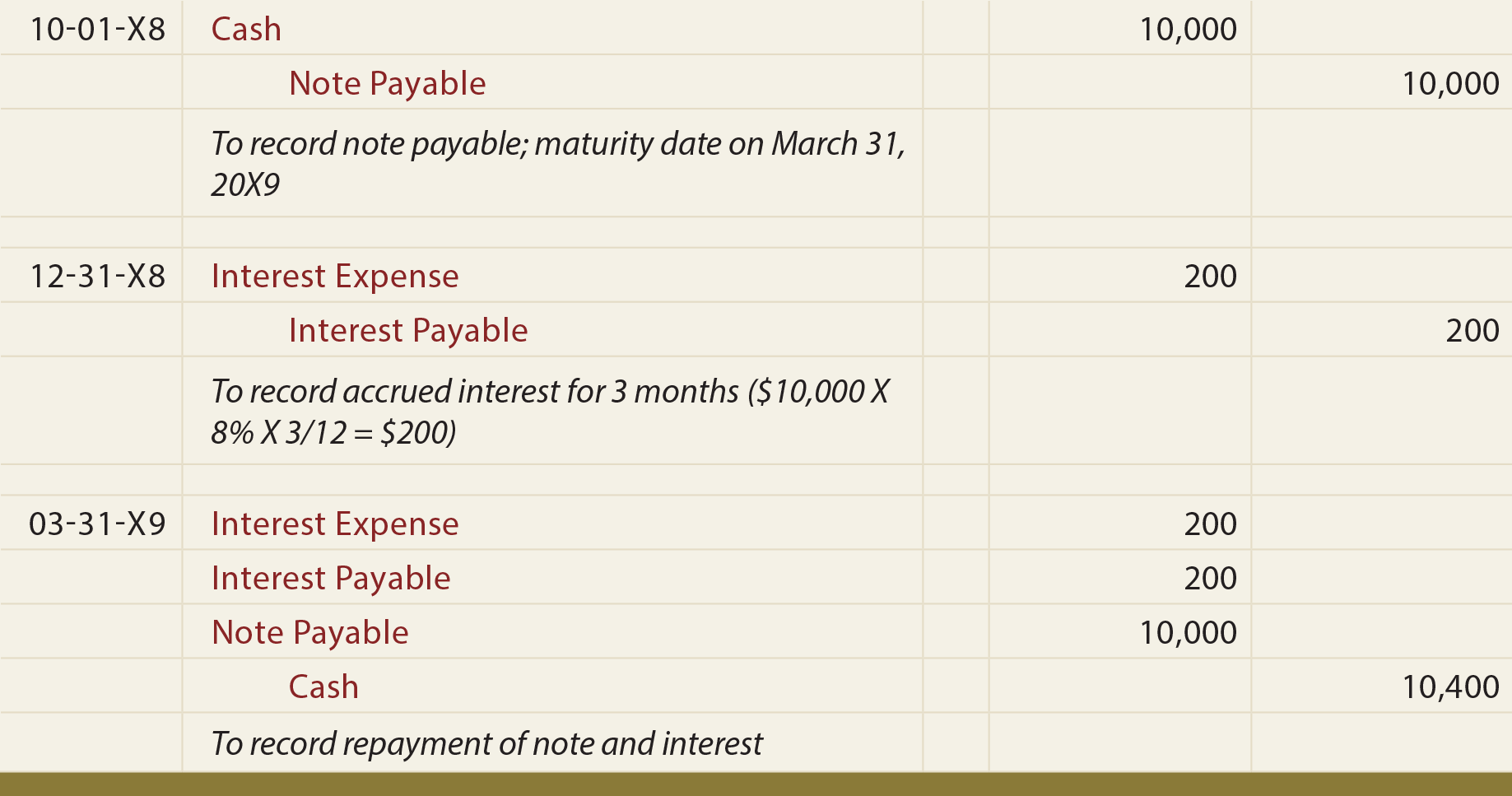
If it is a compound interest, the accrued interest that remains unpaid is added to the principal of note receivable and carried over to the next accounting period. For non-current asset classification, the company must reevaluate the note receivable at the end of each accounting period to identify if its classification has changed. Notes receivable come in the form of a written document that borrowers pay to their lenders. Unlike usual trading balances and credits, notes receivable balances come with additional terms. The journal entry for interest on a note receivable is to debit the interest income account and credit the cash account. For example, the non-interest-bearing note that the company XYZ receives is a $1,000 promissory note with a 2-year maturity and an appropriate discount rate is 8% per annum.
Sometimes accounts receivables are converted into notes receivables to allow the debtors to pay the balance. Notes receivable can arise due to loans, advances to employees, or from higher-risk customers who need to extend the payment period of an outstanding account receivable. Notes can also be used for sales of property, plant, and equipment or for exchanges of long-term assets. Notes arising from loans usually identify collateral security in the form of assets of the borrower that the lender can seize if the note is not paid at the maturity date. As you’ve learned, accounts receivable is typically a more informal arrangement between a company and customer that is resolved within a year and does not include interest payments.
Before realization of the maturity date, the note is accumulating interest revenue for the lender. Interest is a monetary incentive to the lender that justifies loan risk. The interest rate is the part of a loan charged to the borrower, expressed as an annual percentage of the outstanding loan amount. Interest is accrued daily, and this accumulation must be recorded periodically (each month for example). The Revenue Recognition Principle requires that the interest revenue accrued is recorded in the period when earned.
The amount debited to interest receivable represent simple interest earned on note receivable from ABC. Are known, the fifth “unknown” variable amount can be determined using a business calculator or an Excel net present value function. For example, if the interest rate (I/Y) is not known, it can be derived if all the other variables in the equation are known.
In contrast, notes receivable (an asset) is a more formal legal contract between the buyer and the company, which requires a specific payment amount at a predetermined future date. The length of contract is typically over a year, or beyond one operating cycle. There is also generally an interest requirement because the financial loan amount may be larger than accounts receivable, and the length of contract is possibly longer.
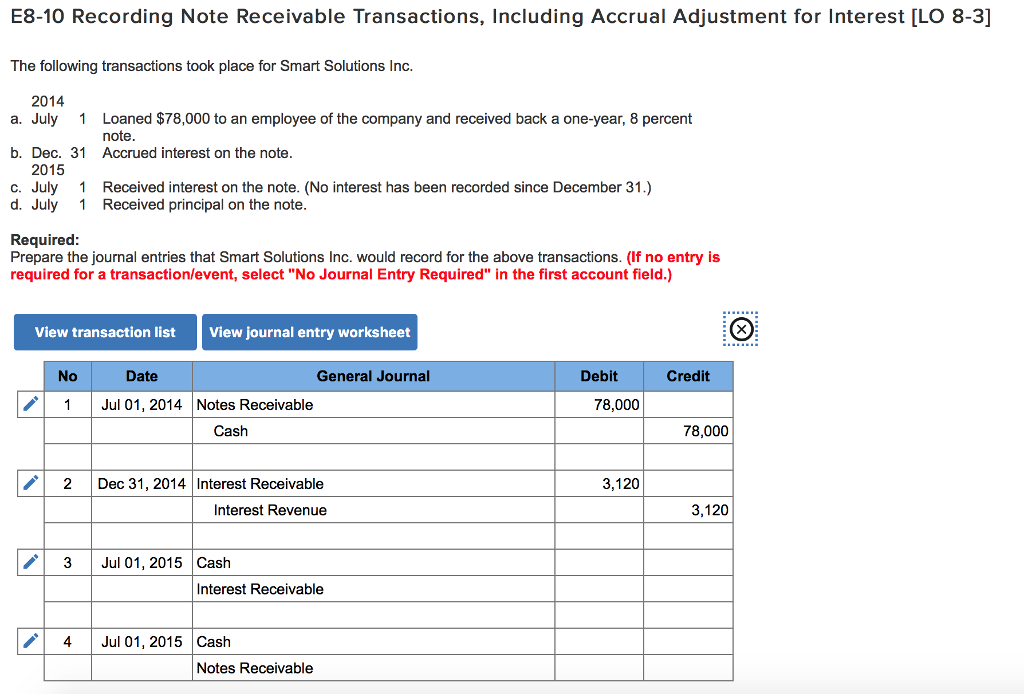
For this reason, notes are negotiable instruments the same as cheques and bank drafts. The journal entry will follow if a company pays another party directly in exchange for a note receivable. In this journal entry, the balance of note receivable will increase by the amount of interest income of the month.
For the purposes of accounting class, we will focus on Accounts Receivable transactions where an Accounts Receivable is turned into a Note Receivable. It has a stronger legal claim than Accounts Receivable, meaning it is more likely to get paid than Accounts Receivable if the maker enters bankruptcy. For how to find the best tax preparer for you Notes due in less than one year, Notes Receivable accounts are listed in the Current Asset section of the Balance Sheet. Notes Receivable due in more than one year are listed in the Long-term Asset section of the Balance Sheet. Where I/Y is interest of .75% each month (9%/12 months) for six months.
In any event, the Notes Receivable account is at the face, or principal, of the note. No interest income is recorded at the date of the issue because no interest has yet been earned. Also, if customers are known to default on paying their accounts, the seller may insist that they sign a note for the balance. The first journal is to record the principal amount of the note receivable.
Square, the mobile payments company, allows small businesses to take credit cards by swiping customer credit cards using a small square device attached to the audio jack found on mobile devices. Since its founding in 2009 and the launch of its first app in 2010, Square has found its way into many small businesses – and large businesses. Starbucks uses Square to process transactions with credit or debit card customers. In November 2014, Square announced that it would be accepting Apple Pay. After 60 days of non-payment, notes payable are issued to MPC by RSP Co. for USD60,000 at an interest rate of 10% per annum and with a payment of USD20,000 due at the end of each of the next 90 days.
We are transitioning the debt from Accounts Receivable to Notes Receivable. Note that some textbooks use 360 days in a year, and some textbooks use 365 days in a year. Using 360 days is a throwback to the very olden days when “calculators” were people who calculated. Square determines the amount to be charged for the loan and the percentage to be charged each day using data analytics.
Poradmin
Rather than just a few chosen tasks, outsourcing accounting enables you to offer bundled service offerings. In addition to tax preparation, they perform other duties like month-end financial reporting, tax advisory, and monthly bookkeeping services. They can either work directly for your clients on a referral basis or through a white-label accounting solution on the back end while you remain on the customer-facing side. Since 2005, Maxim Liberty has offered flexible and affordable outsourced bookkeeping services for CPA firms in Canada and the United States. With plans starting at just $50 a month and the ability to cancel anytime, Maxim Liberty ranks highly in the industry for its high-value bookkeeping services. At QXAS outsourcing, we excel in delivering streamlined auditing solutions.
Prioritize critical tasks essential to your firm’s long-term success while your outsourced accounting team manages routine tasks. Permanently increase your firm’s capacity with a dedicated outsourced accounting team in weeks, not months. Virtual, online, and outsourced accounting can appear the same at first glance, but these terms should not https://quickbooks-payroll.org/ be used interchangeably. However, the difference is simple – ‘All offshore/onshore accounting outsourcing is online or virtual accounting, but all online or virtual accounting is not outsourced accounting. Unlike most other outsourced bookkeepers on our list, Merritt Bookkeeping doesn’t offer any in-house add-ons for payroll and tax services.
So, it is advisable to ask this question to know whether the outsourcing firm can scale up the association with your firm when needed. You must understand the levels of expertise and skillsets of the outsourced accountants working on your project. Also, make sure they have the requisite experience in the kind of work you send their way. Christopher Rivera, Chris serves contribution margin as a Director of Client Relations and Business Development at Entigrity. His expertise in sales, training, coaching, mentoring and influencing combined with his competitive nature makes him a strong leader. Chris has traveled through the length and width of the country and has spoken with more than five thousand CPAs, understanding their challenges and limitations.
For most firms, the journey to accounting outsourcing starts with the need to cut costs and improve scalability during the busy season. While security is an overriding concern with outsourcing, virtual solutions offer expert data protection regardless of the areas outsourced. International services are a thriving area of growth for accounting practices of all sizes.
There are several actions that could trigger this block including submitting a certain word or phrase, a SQL command or malformed data. You can choose Bench if your business has not entered the growth stage yet and it will take some time for your financials to change. So you do not spend on the expensive software but get to reap all the benefits that it has to offer just by paying a monthly fee. As a small business, you might not have sufficient budget to invest in expensive up-to-date software for financial reporting for your business. Businesses often work for years on the same outdated software and miss out on the latest technologies.
Witness Diana’s journey from establishing her CPA firm in the 2020 to harnessing the power of outsourcing, resulting in remarkable client expansion and increased profitability. This is one of the reasons why I like being on the Tax Council because small firms like ours can get the word out there that there is another way. So first you need to identify the kind of solution that your business needs and then pick a solution that best fits it. Before getting started, you will need to have all your bank accounts and records of transactions in place. If you are a small business with under a hundred transactions, the Basic plan might be ideal. If you are currently going through funding rounds, inDinero also has resources to guide businesses through these funding stages.
Give your team the freedom to focus on delivering strategic growth for your firm rather than drowning in non-essential busy work. Outsmart your competitors by adding highly skilled accounting professionals to your firm faster. Check whether the provider has implemented the necessary security controls and is compliant with the required compliance frameworks such as SOC 2, GDPR, ISO 27701, and others. Effective communication with an outsourced team can sometimes be challenging due to differences in time zones and potential language barriers.
Non-profit organizations and charities can also benefit from their expertise. But, payroll, taxes, and invoices are not inclusive of this low-cost service. Instead choose one that integrates with QuickBooks, NetSuite, Xero, and other best accounting software. Also, look for integration for tax and payroll services and other backend processes. QX Accountng Services is a pioneer in bringing a selection of accounting outsourcing services for your accounting firm’s laborious accounting functions.
SmartBooks not only takes care of the bookkeeping for small businesses but provides many other valuable financial services to help small businesses manage their accounts and financial health with ease. ROSE® is a leading Finance as a Service (FaaS) provider, simplifying back-office operations by aligning People, Process, Technology, Organization, and Data. Our cutting-edge system, Easby®, is an enterprise-grade, ai-enabled, hyper-automation system of engagement that transforms data into actionable insights to enhance financial performance.
These savings mean the downward price pressure will not affect your profitability. Outsourcing financial activities are the key to productivity and accuracy. Ignite Spot Accounting delivers heftier reports than many other cloud accounting providers we checked out for this piece. Along with typical financial reporting (like profit and loss reports and balance sheets), you’ll get a KPI (key performance indicator) report and profitability analysis, among others. You have to enter more information about your needs to get a quote—which is useful if you want truly customized services but unhelpful if you’d rather choose a basic plan out of a lineup. With outsourced accounting services, you are taking actionable steps to scale your firm and increase the scope of services.
The Premium plan ($399 a month if billed annually or $499 billed monthly) adds tax advising services, end-of-year tax filing, and financial strategy planning. The team at QX Accounting Services then takes over various accounting tasks, ranging from routine bookkeeping to complex tax preparation and financial analysis. They utilize advanced accounting software and maintain consistent communication with the client to ensure accuracy and transparency. Regular reports and insights are provided, enabling firms to make informed decisions. Full-service outsourcing partners are also available that can offer more substantial accounting services.
Also, check whether the migration of data between the two services is not complex. The business will also follow statutory laws by maintaining financial records. You will also be able to provide quantitative information to investors, managers, and government.
Ultimately, whether to outsource accounting depends on the firm’s specific needs, but the potential benefits make it a strategy worth considering for efficiency, growth, and competitive advantage. Paro only accepts the top 2% of applicants with 15 years of experience on average to their platform. These individuals can be hired on demand to fill temporary vacancies or partner with you long-term. However, while your outsourcing partner can prepare these statements to save you time and resources, you will likely review them for accuracy before passing them on to your clients. The integration of AI in accounting has been a measured journey marked by careful acceptance and steady adoption. Today, AI is not merely a trendy term in the accounting industry; it’s a transformative tool reshaping the execution of accounting tasks.
Poradmin
Assets are typically listed as individual line items and then as total assets in a balance sheet. You will need to tally up all your assets of the company on the balance sheet as of that date. Noncurrent or long-term liabilities are debts and other non-debt financial obligations that a company does https://www.wave-accounting.net/ not expect to repay within one year from the date of the balance sheet. For instance, if a company takes out a ten-year, $8,000 loan from a bank, the assets of the company will increase by $8,000. Its liabilities will also increase by $8,000, balancing the two sides of the accounting equation.
These revenues will be balanced on the asset side of the equation, appearing as inventory, cash, investments, or other assets. If the company takes $10,000 from its investors, its assets and stockholders’ equity will also increase by that amount. Horizontal balance sheets show Assets on the left side and Liabilities and Shareholders’ Equity on the right side of the balance sheet.
If a balance sheet doesn’t balance, it’s likely the document was prepared incorrectly. External auditors, on the other hand, might use a balance sheet to ensure a company is complying with any reporting laws it’s subject to. Typically, a balance sheet will be prepared and distributed on a quarterly or monthly basis, depending on the frequency of reporting as determined by law or company policy. Here’s everything you need to know about understanding a balance sheet, including what it is, the information it contains, why it’s so important, and the underlying mechanics of how it works. Although balance sheets are important, they do have their limitations, and business owners must be aware of them. It is also helpful to pay attention to the footnotes in the balance sheets to check what accounting systems are being used and to look out for red flags.
Businesses compute Days Receivable Outstanding (DRO) and Days Payable Outstanding (DPO), which relate to accounts receivable and accounts payable turnover. Liabilities are presented as line items, subtotaled, and totaled on the balance sheet. Now that we have seen some sample balance sheets, we will describe each section of the balance sheet in detail. We also allow you to split your payment across 2 separate credit card transactions or send a payment link email to another person on your behalf. If splitting your payment into 2 transactions, a minimum payment of $350 is required for the first transaction.
On the other hand, balance sheets for mid-size private firms might be prepared internally and then reviewed over by an external accountant. The data and information included in a balance sheet can sometimes be manipulated by management in order to present a more favorable financial position for the company. Business owners use these financial ratios to assess the profitability, solvency, liquidity, and turnover of a company and establish ways to improve the financial health of the company. Using financial ratios in analyzing a balance sheet, like the debt-to-equity ratio, can produce a good sense of the financial condition of the company and its operational efficiency.
Note that in our model, the “Total Assets” and “Total Liabilities” line items include the values of the “Total Current Assets” and “Total Current Liabilities”, respectively. In other instances, it is common to see the two separated into bookkeeping for auto repair shops “Current” and “Non-Current”. But rather than copying every single data point in the same format as reported by Apple in their public filings, discretionary adjustments that we deem appropriate must be made for modeling purposes.
Long-term liabilities, on the other hand, are due at any point after one year. This is the value of funds that shareholders have invested in the company. When a company is first formed, shareholders will typically put in cash. Cash (an asset) rises by $10M, and Share Capital (an equity account) rises by $10M, balancing out the balance sheet.
It might seem overwhelming at first, but getting a handle on everything early will set you up for success in the future. Today, we’ll go over what a balance sheet is and how to master it to keep accurate financial records. Depending on the company, different parties may be responsible for preparing the balance sheet. For small privately-held businesses, the balance sheet might be prepared by the owner or by a company bookkeeper. For mid-size private firms, they might be prepared internally and then looked over by an external accountant.
This is an important document for potential investors and loan providers. When investors ask for a balance sheet, they want to make sure it’s accurate to the current time period. It’s important to keep accurate balance sheets regularly for this reason. Total assets is calculated as the sum of all short-term, long-term, and other assets. Total liabilities is calculated as the sum of all short-term, long-term and other liabilities. Total equity is calculated as the sum of net income, retained earnings, owner contributions, and share of stock issued.
That is, assets are on the left; liabilities and stockholders’ equity are on the right. If you’ve found that your balance sheet doesn’t balance, there’s likely a problem with some of the accounting data you’ve relied on. Double check that all of your entries are, in fact, correct and accurate. You may have omitted or duplicated assets, liabilities, or equity, or miscalculated your totals.
Using the screenshot from earlier, we’ll enter Apple’s historical balance sheet into Excel. The three parts of the balance sheet are described in the following table. Liabilities may also include an obligation to provide goods or services in the future.
It is also known as net assets since it is equivalent to the total assets of a company minus its liabilities or the debt it owes to non-shareholders. Accounts within this segment are listed from top to bottom in order of their liquidity. They are divided into current assets, which can be converted to cash in one year or less; and non-current or long-term assets, which cannot.
Apple’s total liabilities increased, total equity decreased, and the combination of the two reconcile to the company’s total assets. Understanding and analyzing key financial statements like the balance sheet, income statement, and cash flow statement is critical to painting a clear picture of a business’s past, present, and future performance. Knowing what goes into preparing these documents can also be insightful. Balance sheets are one of the core financial statements presented in business plans and financial models for analyzing potential M&A transactions and establishing a valuation. These balance sheets are prepared with assumptions as estimated projections of future assets, liabilities, and shareholders’ equity. Although the balance sheet is an invaluable piece of information for investors and analysts, there are some drawbacks.
The common stock and preferred stock accounts are calculated by multiplying the par value by the number of shares issued. Includes non-AP obligations that are due within one year’s time or within one operating cycle for the company (whichever is longest). Notes payable may also have a long-term version, which includes notes with a maturity of more than one year.